



Introduction
The global investment landscape is undergoing a structural shift as investors increasingly look beyond traditional asset classes in pursuit of diversification, stability, and stronger long-term returns. Alternative investments, once largely confined to institutional portfolios, are now attracting growing interest from retail investors. This shift is reshaping how alternative investments are designed, distributed, and accessed, creating new opportunities as well as new challenges for asset managers, intermediaries, and investors alike.
According to Preqin, the global alternatives industry is projected to expand from USD 18.5 trillion in assets under management in 2024 to USD 31.8 trillion by 2030, representing annualized growth of 9.7%. Alternative assets are therefore no longer a peripheral segment of the investment industry, but an increasingly important part of its future growth.
As this market expands, retail investors are increasingly seeking a place within it. According to Cerulli Associates, alternative investment managers derived about 13% of their AUM from retail clients in 2024, a share projected to rise to 23% by 2028. This points to a broader shift, as alternative investments move from a niche institutional offering toward a mainstream component of retail portfolios. As private markets become more accessible, success will increasingly depend not only on investment performance but also on the industry’s ability to deliver retail-friendly products, scalable distribution models, and a seamless investor experience.
The Growth of Alternative Investments Market
The alternative investment market is evolving both in scale and composition. While private equity remains the largest asset class, private credit, infrastructure, real estate, and venture capital continue to expand, reflecting the increasing breadth and maturity of the alternatives ecosystem.
Preqin forecasts annualized AUM growth between 2024 and 2030 of 13.6% for private credit, 12.9% for infrastructure, 11.1% for private equity, 10.3 % for venture capital, 7.4% for private real estate, and 4.1% for hedge funds. The stronger growth outlook for private credit reflects rising demand for flexible, non-bank financing, while infrastructure growth is driven by long-term investment in energy transition and digital infrastructure.
Global Alternatives Assets Under Management by Asset Class (2020-2030)
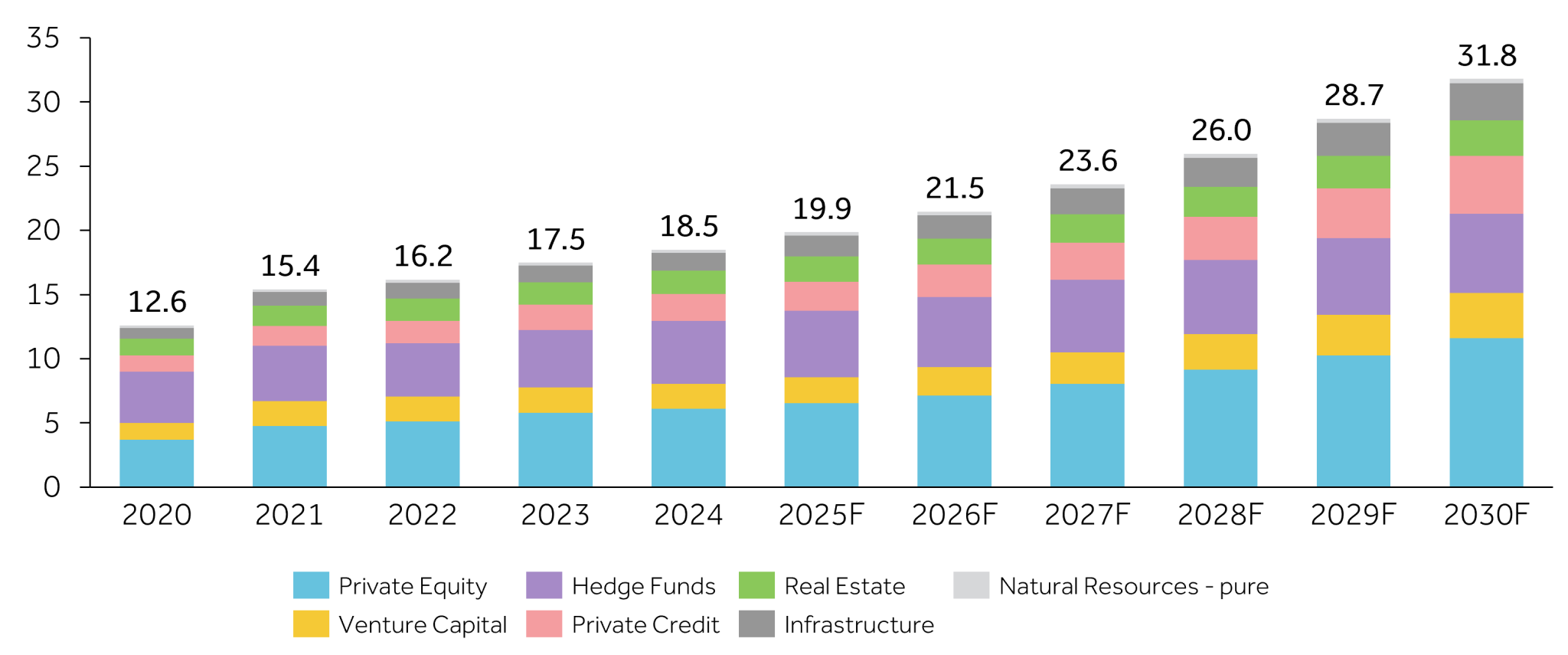
Source: Preqin Private Market Forecast Report (2025)
Retail participation in alternative investments has accelerated in recent years and is projected to be the fastest growing investor segment in the overall alternatives market. Retail alternatives AUM is expected to rise from approximately USD 4 trillion in 2024 to nearly USD 12 trillion by 2034, underscoring a major shift in investor composition.
Unlike institutional investors, retail investors require simpler structures, lower entry points, clearer disclosures, more frequent reporting, and greater liquidity flexibility. As a result, the next phase of alternatives growth will depend not only on investment performance, but also on whether the industry can build access models that are understandable, scalable, and appropriate for individual investors.
What is Expanding Retail Access to Alternative Investments?
The rapid growth of alternative investments has strengthened the commercial case for serving individual investors, but market expansion alone does not amount to democratization. Wider participation depends on addressing the regulatory, product-design, and distribution barriers that historically kept these investments within institutional portfolios.
These barriers are now being tackled through regulatory reforms, retail-friendly product structures, and digital distribution infrastructure. At the same time, growing investor demand for diversification and income is accelerating adoption. Together, these supply- and demand-side forces are expanding both the availability of alternative investments and the channels through which individual investors can access them.
Regulatory Reform
Regulatory developments across major financial markets are gradually expanding retail access while maintaining investor protection standards. Policymakers are introducing revised fund frameworks, disclosure requirements, and eligibility norms that lower entry barriers and encourage broader participation.
For instance, in the United States, evolving regulatory guidance is encouraging greater inclusion of alternative assets within defined contribution retirement plans, such as 401(k) plans. The guidance emphasizes reducing regulatory and litigation barriers while maintaining fiduciary safeguards, signalling a policy shift toward enabling broader retail access to private market investments through retirement vehicles.
Similarly, the European Union’s revised European Long Term Investment Fund (ELTIF) 2.0 regulation is designed to facilitate access for retail investors to long‑term alternative assets such as infrastructure, private equity, private credit, and real estate, by easing diversification requirements, simplifying distribution rules, and lowering minimum investment thresholds. Industry analysts suggest that these reforms could attract up to EUR 100 billion in new flows into ELTIFs by 2028.
Such reforms are strengthening the structural foundations for broader retail participation in private markets. By balancing accessibility with enhanced disclosure and suitability safeguards, policymakers are fostering a more scalable and resilient alternative investment ecosystem, positioning them as an increasingly mainstream portfolio allocation avenue for individual investors.
Digital Distribution and Operating Infrastructure
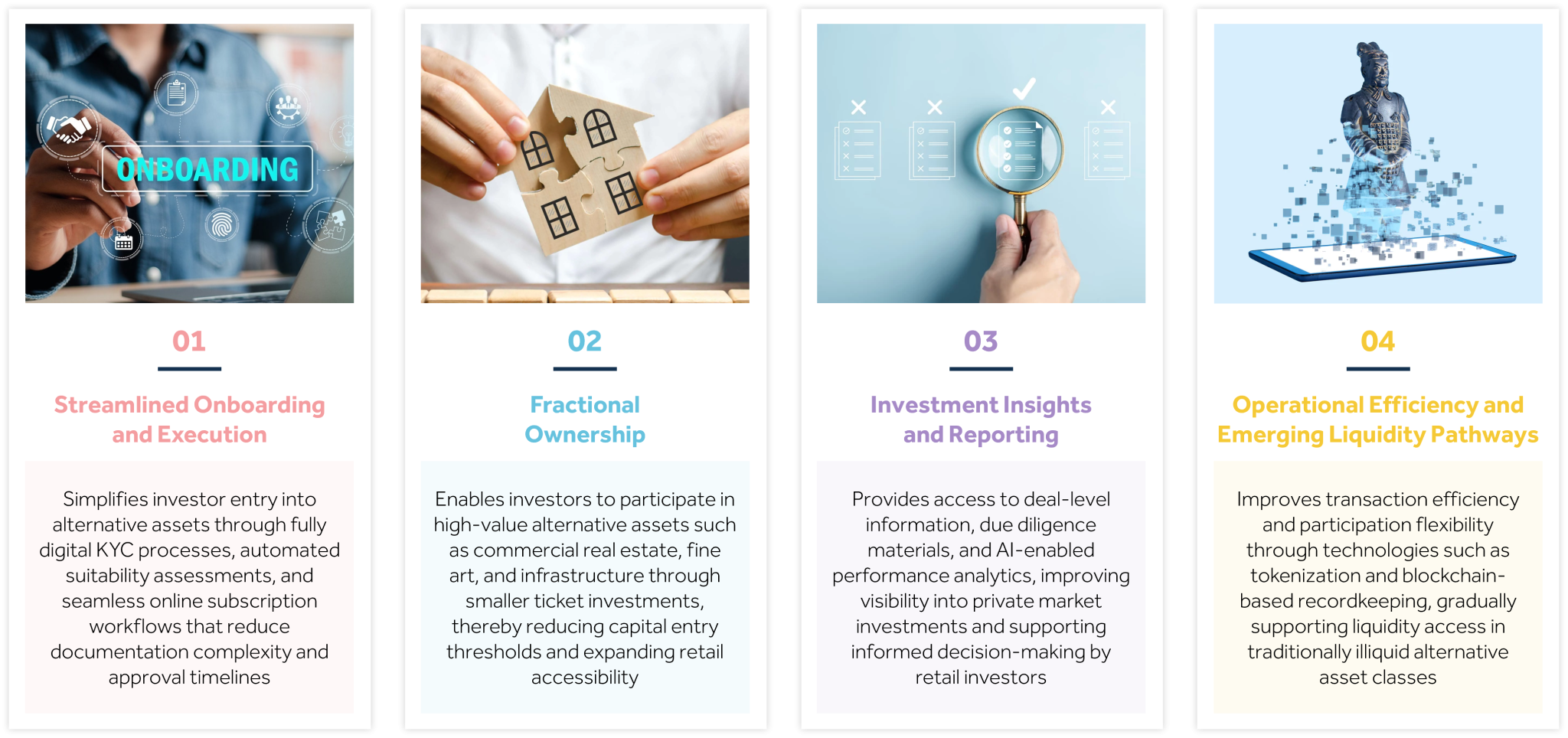
Technology is becoming a critical enabler of broader access to alternative investments by digitizing and simplifying the end-to-end investment process. Digital platforms are reducing friction across subscription documentation, investor eligibility checks, fund discovery and selection, reporting, portfolio monitoring, and advisor workflows, making private market products easier to distribute, manage, and scale across a wider investor base.
Beyond improving the investor experience, digital infrastructure also enables asset managers to distribute alternative investments at scale. By automating onboarding, compliance, reporting, and investor servicing, technology significantly reduces the operational complexity of serving large numbers of individual investors, making retail distribution commercially viable.
Retail-Friendly Product Structures
Traditional private market funds were designed mainly for institutional investors, with high minimum commitments, capital calls, long lock-up periods, and limited interim liquidity. To broaden access, asset managers have developed new fund structures that are better suited to the needs of individual investors.
For instance, evergreen funds allow investors to enter and exit through an open-ended structure rather than committing to a fixed vintage fund, which typically raises capital during a defined period and invests it over a fixed fund life. Interval funds offer periodic repurchase windows, although the liquidity remains limited and redemptions may not be available on demand.
Similarly, liquid alternative funds use more traditional mutual fund or ETF-like structures to provide exposure to non-traditional strategies with more frequent liquidity. Alternative mutual funds generally offer daily redemptions at net asset value, while alternative ETFs are listed on exchanges and can be traded throughout the day.
These structures are important because they translate institutional-style exposures into formats that are easier for advisors and private clients to allocate to. However, they do not eliminate the underlying trade-off between access and liquidity; they simply manage that trade-off in a more retail-compatible format.
Macroeconomic Pressures and Market Fatigue
A major driver of retail interest in alternatives is the growing fatigue with volatile and relatively low-yielding public markets. Periods of market uncertainty, persistent inflationary pressures, tightening financial conditions, and heightened geopolitical tensions have increased risk perceptions around traditional asset classes. These dynamics, combined with structurally lower expected returns from equities and bonds are reinforcing the relative attractiveness of private capital opportunities.
At the same time, structural changes in capital markets are strengthening the case for private market investing. The shrinking pool of publicly traded companies in major markets further limits the range of accessible investment opportunities for investors. As a result, individual investors are increasingly allocating to alternative assets to access differentiated growth potential and improve portfolio diversification across economic and geopolitical cycles.
How Is Democratization Changing Asset Managers’ Business Models?
The democratization of alternatives is forcing asset managers to shift from an institution-only operating model to a hybrid model that can serve institutions, private banks, wealth advisors, and individual investors. This has implications across four areas: product design, distribution, operations, and governance.
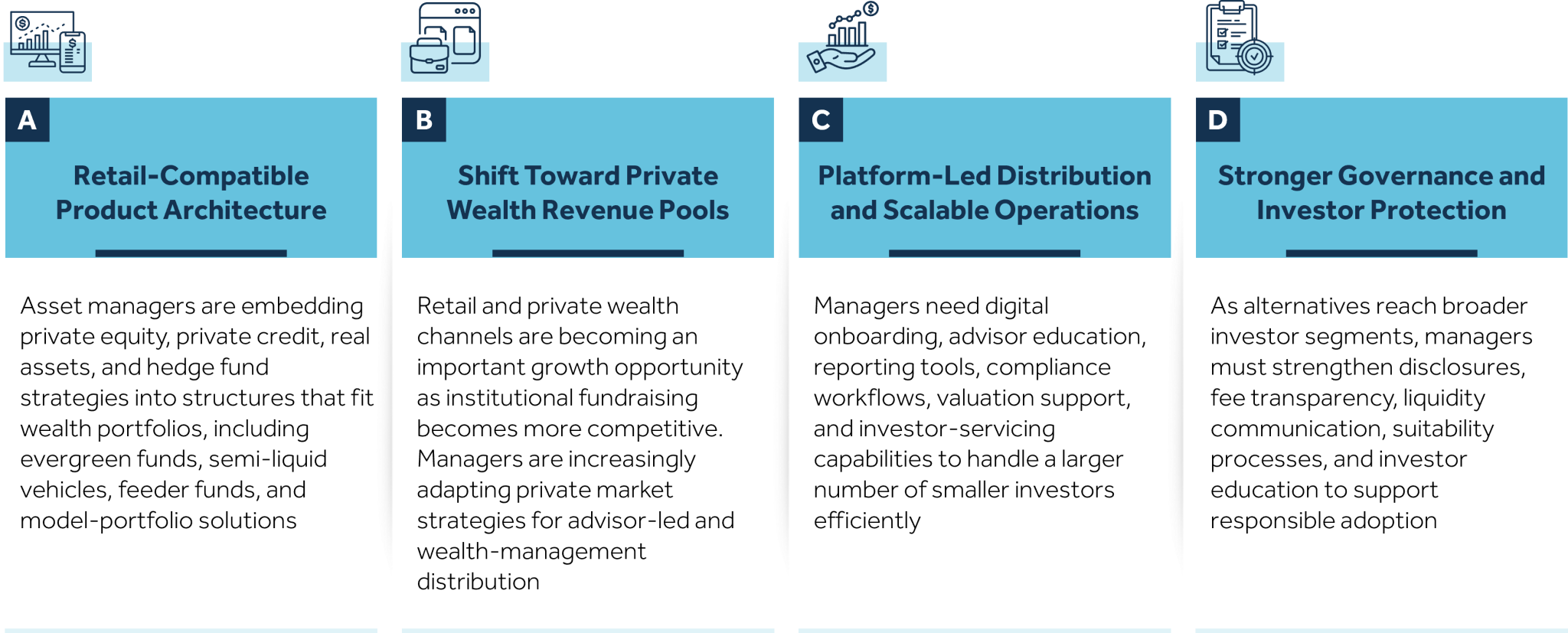
What challenges of alternative investments may limit adoption by retail investors?
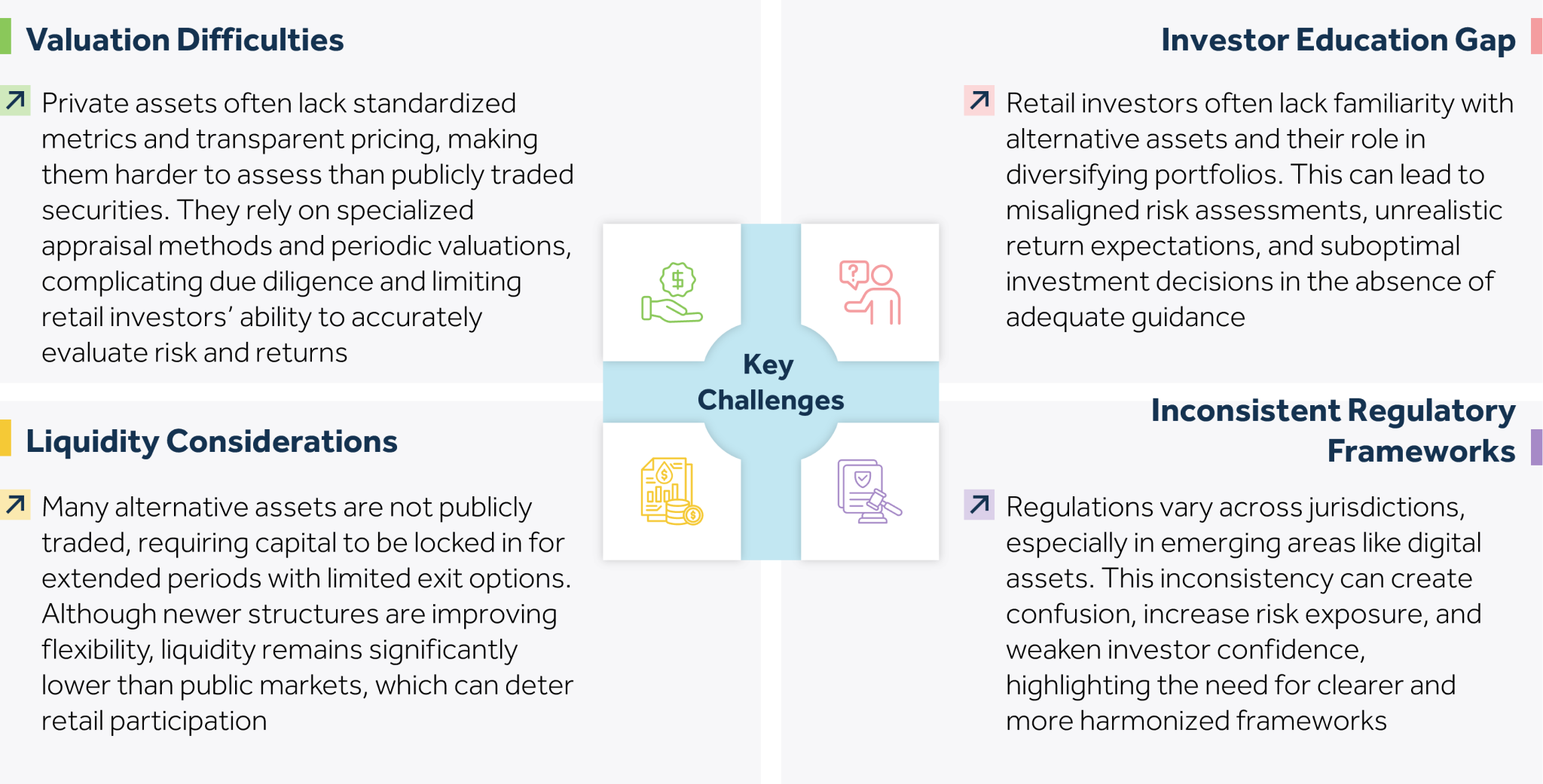
While the potential for higher returns is a significant draw, several structural and operational challenges continue to limit the widespread adoption of alternative investments among retail investors, including limited understanding of alternative investments market, valuation complexities, and relatively limited liquidity options.
How is the Middle East enabling democratization of alternative investments?
The democratization of alternative investments in the Middle East is still at a nascent stage, with progress being driven primarily by regulatory reforms and technology enabled distribution rather than broad based retail participation. While access remains limited relative to more mature markets, regulators and market participants have begun laying the groundwork for the gradual expansion of retail access to selected alternative asset classes.
A key enabler has been regulatory reform aimed at lowering structural entry barriers for non-institutional investors. Regulators in markets such as Saudi Arabia and the UAE have introduced frameworks that permit fractional ownership structures across asset classes including real estate and private credit. These measures reduce minimum investment thresholds and allow a wider investor base to participate in income generating alternative assets, while maintaining regulatory oversight and investor protection.
These regulatory initiatives are being operationalized through digital investment platforms that allow individuals to invest through fractional units and receive proportional returns. Such platforms play a central role in translating regulatory intent into practical retail access by simplifying onboarding, transaction execution, and portfolio administration. In parallel, regulators are gradually expanding the availability of retail accessible instruments, including digitally distributed sukuk and distribution through banking and wealth management channels, increasing product availability for non-institutional investors.
Despite these developments, retail participation in alternatives remains concentrated in select asset classes, particularly real estate, and is largely intermediated through regulated platforms and institutional distribution channels. Broader access across a wider range of alternative investments, as well as deeper and more direct retail participation, is still evolving. Overall, while the Middle East has begun lowering structural barriers through regulation and technology enabled distribution, the transition toward fully democratized access to alternative investments remains gradual, controlled, and policy driven.
Conclusion
Private markets are entering a new phase of growth as alternative investments become increasingly accessible. The expansion of semi-liquid structures, perpetual-life funds, digital distribution platforms, along with regulatory reforms is expected to broaden participation from retail investors. For asset managers, this shift could create larger and more diversified funding pools while reducing dependence on cyclical institutional allocations.
The Middle East is well positioned to capture a meaningful share of this opportunity, supported by rising private wealth, expanding financial infrastructure, growing digital investment adoption, and regulatory reforms aimed at widening investor access. As private equity ecosystems scale and digital investment adoption accelerates, the region could evolve from being primarily a capital provider to becoming an active retail distribution market for alternative assets.
Over time, alternatives are likely to become a more established component of mainstream retail portfolios, resulting in hybrid allocation models that combine public-market liquidity with long-term private market exposure. However, sustained adoption will depend on stronger investor education, clear regulation, transparent pricing, and products that provide an appropriate balance between accessibility, liquidity, returns, and risk. Asset managers that can address these requirements are likely to be best positioned to benefit from the next phase of private market growth.
References
World Economic Forum (2026)
Capgemini (2025)
BNY (2025)
Preqin (2024)
Preqin Private Market Forecast Report (2025)
International Journal of Innovative Science and Research Technology (2025)
Infosys (2024)
KPMG (2025)
Fund Society (2025)
Goldman Sachs (2025)
EY GCC Wealth Management Industry Report (2025)
Alternative Credit Investor (2024)
BNP Paribas (2026)
MENA Fintech Association (2026)
IQEQ (2025)
The White House (2025)
U.S. Securities and Exchange Commission (2025)
Uncorrelated (2026)
Global Investment Law Watch (2025)
Investment Company Institute (2025)