



Microlearning: Short, Focused, On-Demand
In a world where information moves faster than ever, traditional models of education and training are struggling to keep pace. Learners today expect knowledge to be accessible in the same way they consume everything else, quick, on-demand, and in formats that fit into busy lives. This shift in expectations has given rise to new learning models built around short, targeted bursts of content instead of long, one-size-fits-all courses.
Microlearning is rapidly becoming a cornerstone of modern education and professional training. It delivers short, focused bursts of content that help learners grasp key concepts quickly, often in under 10 minutes. Unlike traditional learning formats, microlearning is designed to be accessed on-demand, supporting learners in real time as they face specific tasks or challenges.
This approach is particularly effective in fast-paced environments, where carving out hours for in-person or even virtual classes is often unrealistic. Whether it’s a quick refresher on compliance rules or a bite-sized tutorial on a new software feature, microlearning empowers learners to get exactly what they need, when they need it.
What is Microlearning?
While video is the most recognized form of microlearning, especially in today’s digital culture, it is far from the only medium. Self-paced e-learning, job aids, games, blogs, infographics, podcasts, and simulations all fall under the microlearning umbrella. The key is not the format but the focus: delivering “need to know” information, not “nice to know” extras.
Most experts agree that microlearning segments should cover one or two learning objectives and not be bound by arbitrary time limits. That said, the Association for Talent Development suggests:
- 13 minutes is the upper boundary for content to still qualify as microlearning
- 10 minutes is considered the ideal average length
- 2–5 minutes is seen as the most effective duration for engagement and retention
As learners shift to digital-first platforms, microlearning fits naturally into familiar spaces like social media.
Trending Types of Educational Content
A range of content styles has emerged as go-to formats for delivering educational value in seconds:
What binds these formats together is the rise of edutainment, a hybrid style that prioritizes clarity, authenticity, and engagement. Creators who teach well are often those who also entertain well, using humor, storytelling, and strong visuals to enhance retention.

The Rise of AI-Generated Explainers in Microlearning
AI is becoming a core enabler of microlearning by simplifying content creation, accelerating delivery, and enabling large-scale personalization. Educators and organizations are increasingly turning to AI tools to generate short, targeted lessons across video, audio, and interactive formats.
Recent studies highlight the effectiveness of these methods:
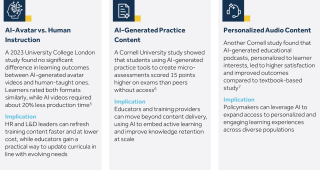
As AI capabilities continue to advance, its role in microlearning is becoming more integral, enabling faster content development, increased scalability, and enhanced learner relevance. As these tools mature, the cost of creating microlearning will fall, but the real competitive advantage will lie in how organizations integrate these AI-enabled modules into accredited learning pathways and formal capability frameworks.
Corporate L&D is Taking Note
Microlearning is reshaping how companies train, onboard, and upskill their workforce. As the pace of work accelerates and employees juggle competing priorities, organizations are turning to microlearning as a practical, flexible, and cost-effective solution for corporate training.
Its appeal is driven by measurable outcomes:
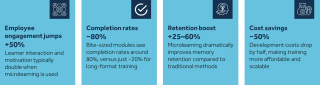
Beyond efficiency, microlearning is helping companies build a learning culture that adapts to how modern teams work. It supports flexible, self-directed development across hybrid and remote environments, helps close skills gaps quickly, and fits seamlessly into the workday.
Evaluating Microlearning: Potential and Pitfalls
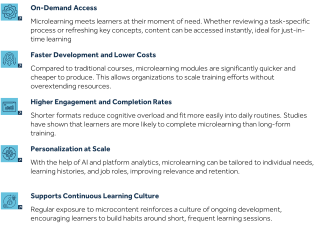
As microlearning gains momentum across education and workforce training, it presents clear advantages, but also important constraints. Understanding both is key to using it effectively.
Potential
Pitfalls

Conclusion
Microlearning has proven to be an effective and adaptable approach to education and workforce development. Its short, focused format aligns well with how people consume information today, offering practical benefits in both learning outcomes and implementation efficiency.
Yet its true value lies ahead. As digital tools mature and AI expands personalization, microlearning can become a strategic lever for organizations and governments alike: enabling rapid reskilling in fast-changing labor markets, embedding continuous learning into workplace culture, and extending equitable access to learners who might otherwise be left behind.
For governments, educators, and corporates, the opportunity lies in treating microlearning not as a standalone trend but as a core element of broader learning ecosystems. Positioned this way, it has the potential to make lifelong learning more agile, inclusive, and responsive to rapid change.
Sources
- Association for Talent Development
- TikTok LearnOn
- he Economic Times
- We are Social – Global Digital Report
- University College London
- Cornell University
- Cornell University
- eLearning Industry
Related articles

AI for AI: Artificial Intelligence for Accessibility and Inclusion in Education

Food Delivery Platforms: Revenue Growth vs. Profitability

Social Media as a Learning Environment
What began as platforms for entertainment have evolved into unexpected educational ecosystems. Short-form videos, such as TikToks and Youtube Shorts, have proven to be the perfect medium for rapid knowledge transfer. With billions of users and algorithm-driven feeds, these platforms surface content tailored to individual interests, including education
This surge of bite-sized educational content has also fueled new styles of teaching that blend clarity with entertainment