


Bridging the Accessibility Gap
Globally, there are over 240 Mn children that live with disabilities, and many continue to face persistent barriers in accessing education. Children with disabilities are 49% more likely to have never attended school, while neurodivergent students often struggle with environments that overlook their needs, from crowded lecture halls to constant sensory overload. These barriers are not just about physical infrastructure but also how learning environments are designed, and for whom.
Artificial Intelligence (AI) offers new ways to level the playing field. Tools like speech-to-text software, adaptive learning platforms, and real-time feedback systems provide personalized support that helps students learn in ways that suit them best. Inclusive education is not just about access, it’s about equity, ensuring all learners, regardless of ability, can attain quality education and thrive.
For neurodivergent students, success often depends on how well systems accommodate their energy, focus, and sensory needs. While many manage these factors independently, most education systems still lack structured support. AI-powered personalization can help close this gap, offering individualized pathways that adapt to students’ unique strengths and challenges.
The Power of Universal Design for Learning
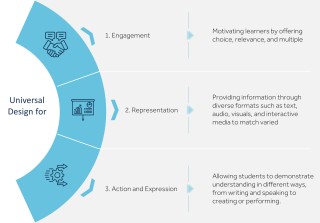
The concept of Universal Design for Learning (UDL)
provides a foundation for accessibility in education. Developed by the Center for Applied Special Technology (CAST) in the 1990s, UDL was inspired by universal design in architecture, creating spaces that are usable by all, without needing later modifications. Since then, UDL has been applied across a wide range of fields, and in education it has become a guiding framework for building learning experiences that proactively support the full spectrum of learner needs.
UDL is anchored in three core principles:
AI-driven tools are transforming classrooms into more adaptive, inclusive spaces. Technologies like natural language processing, computer vision, and predictive analytics help educators tailor content to each student’s needs. While students with disabilities are generally among the most disadvantaged or least able to benefit from technological advancements; now, AI is expanding access and enabling individualized instruction that empowers all learners to reach their full potential.
Global Progress Towards Driving Accessibility
Around the world, education systems and technology developers are increasingly recognizing accessibility as a central pillar of innovation. Governments, universities, and private companies are using AI to remove barriers for learners with disabilities and to create classrooms that adapt to diverse cognitive and physical needs. The focus is shifting from accommodation to inclusion by design, where accessibility is integrated from the very beginning of product and curriculum development.
Globally, AI tools are already changing how students interact with information. Microsoft’s Immersive Reader enables users to customize text appearance and provides grammar color-coding and syllable breaks to support reading comprehension for learners with dyslexia and visual impairments. In partnership with OpenAI, Microsoft’s Be My AI tool within the Be My Eyes app offers real-time image descriptions for users who are blind or have low vision, turning visual information into conversation. Similarly, Google’s Lookout app uses computer vision and generative AI to describe surroundings and objects aloud, allowing visually impaired students to navigate classrooms and educational materials more independently.
Collectively, these advances signal a growing commitment to AI-enabled accessibility as a global norm. This momentum is now visible across the Gulf Cooperation Council (GCC), where countries are adapting global best practices to their national contexts and embedding accessibility within their own AI and education strategies.
AI in the GCC: Regional Progress Toward Inclusion
Building on this global momentum, countries across the Gulf Cooperation Council (GCC) are localizing inclusive AI practices within their own education and innovation ecosystems. Governments are aligning national AI strategies with accessibility objectives, ensuring that technology-driven transformation benefits learners of all abilities. The focus is shifting toward inclusive design across public education, digital services, and workforce development, making accessibility a built-in component of national digital agendas rather than a separate initiative.
Saudi Arabia, through the Saudi Data and Artificial Intelligence Authority (SDAIA), and the UAE, through its Ministry of AI, Digital Economy, and Remote Work Applications, are leading this regional shift toward inclusive, AI-enabled education. Bahrain, Kuwait, Qatar, and Oman have also embedded AI into education reform and public-sector innovation programs to promote inclusion and equity.
United Arab Emirates
In the UAE, the government has implemented the Adaptive Learning Framework (Alef) across public schools, a personalized learning platform that tailors lessons to individual student needs. Reaching over 1.1 million users globally, Alef makes digital learning more interactive, equitable, and accessible for K–12 students.
Saudi Arabia
In Saudi Arabia, AI tools such as adaptive interfaces, real-time assessments, and text-to-speech systems support students with disabilities in line with Vision 2030’s goals of equity and lifelong learning. King Saud University has collaborated with AI developers to create text-to-audio and screen-reading tools for visually impaired students, ensuring inclusivity in higher education.
Qatar
In Qatar, the Mada Assistive Technology Center champions digital inclusion through training, technology provision, and research. Its Mada Academy delivers AI and VR enhanced learning experiences for students with hearing impairments, including the JUMLA Sign Language project, which uses avatar technology to teach and analyze Arabic Sign Language.
Risks and Ethical Challenges
While AI holds immense promise for accessibility, it also introduces risks that must be carefully managed:
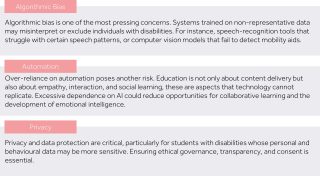
Ultimately, responsible AI integration requires human-centered design, ethical oversight, and adherence to universal design principles. This helps ensure that technology amplifies inclusion rather than inadvertently reinforcing exclusion.
Conclusion
AI is redefining what inclusion can look like in education. Innovations such as eye-tracking, voice recognition, and sign-language avatars are helping students access information, communicate, and learn independently. When built on universal design and guided by ethical intent, AI can transform accessibility from a compliance requirement into a cornerstone of education — creating learning environments where every student, regardless of ability, can thrive.
Related articles


From Long Lessons to Microlearning: Rethinking How We Learn

Food Delivery Platforms: Revenue Growth vs. Profitability